

How To Install Ryzen 5 3600 Cpu
Interesting Overclocking Findings
We noticed that, interestingly, our R9 3900X and R7 3700X overclocked with much lower voltage requirements than our R5 3600. Our R5 3600 is a production sample from a third party, and so we take two thoughts, here: (1) Near realistically, the R5 CPUs probably aren't binned every bit aggressively as the 12-core part, which would demand lower voltages for thermal reasons, and (2) the samples AMD shipped had paste left over on them and they were pretested. We don't doubtable they were binned by AMD for reviewers, though we did want to signal it out. With a sample size of one each, nosotros can't describe conclusions -- perchance it's luck or maybe R5 just runs with a higher voltage. The upside is that the express R5 cadre count means it tin can take the college voltages every bit in that location'due south lower thermal density to misemploy. Our R9 3900X could practise 4.3GHz all-core at 1.34V to one.35V, the R7 3700X could hold similar voltages, simply the R5 3600 required 1.43V for 4.3GHz all-core. We were able to push button 4.4GHz on the 3900X with SMT disabled, shown in our 3900X review that's still rendering at time of writing this, but nosotros could not attain 4.4GHz on any fleck under 1.46V. We stopped at 1.46V as we encountered issues with, predictably, thermals on a reasonable 280mm CLC. Nosotros'll push harder with liquid nitrogen later in the calendar week.
Finally, FCLK will be a big part of memory overclocking afterwards on. We've done some infinity fabric FCLK tuning and constitute no meaningful change when memory is left to our standard examination 3200MHz settings, at least not immediately, and so we'll need to table this for now and dig in more subsequently. Proceed in listen that we had to write and film 5 content pieces relating to AMD products in just a few days, then some sacrifices were fabricated. More often than not to health, granted, but we did remove some tests from content for after benchmarking.
Finally, related to sacrificing sleep, please be advised that there are definitely going to be grammatical typos in this article. We simply don't have infinite time, so we won't comb through it for misspellings. Thanks for your understanding!
Let's become started.
CPU Test Methodology
Our CPU testing methodology is split into two types of benchmarks: Games and workstation workloads, only every CPU which is sufficiently loftier-end volition go through both sets of tests. We are beginning to spend more than attempt publicly documenting the exact versions of our tests, hoping that this is helpful to those reading our tests. We are besides detailing more explicitly the unit of measurement in text, although our charts typically do this too. Our workstation benchmarks include the following tests:
- 7-ZIP Compression benchmark (version 1806 x64). Unit of measurement: MIPS (millions of instructions per second; higher is better)
- 7-Naught Decompression benchmark (version 1806 x64). Unit of measurement: MIPS (millions of instructions per second; higher is improve)
- 7-ZIP lexicon size is 2^22, 2^23, 2^24, and 2^25 bytes, four passes and and then averaged. Thread count equals the CPU thread count.
- Blender ii.79 GN Logo render (frame from GN intro blitheness, heavy on ray-tracing). Unit of measurement: Render fourth dimension in minutes (lower is better)
- Blender 2.79 GN Monkey Heads return (CPU-targeted workload with mixed assets, transparencies, and effects). Unit of measurement: Render time in minutes (lower is better).
- GNU Compiler Collection (GCC) version vii.4.0, compiling 8.two.0 on Windows x. Unit of measurement of measurement: Render time in minutes (lower is meliorate). Run with Cygwin environment.
- Chaos Group V-Ray CPU Criterion (1.0.eight). Unit of measurement: Render time in minutes (lower is improve)
- Cinebench R15 (used for internal validation). Unit: CB Marks (college is better)
- TimeSpy Physics. Unit: 3DMark points & FPS (higher is amend)
- Adobe Photoshop CC 2022 (Puget xviii.10). Unit of measurement: Boilerplate score (higher is improve)
- Adobe Premiere & AME CC 2022 (GN exam suite: 1080p60 convention shot; H.264, 35Mbps, 5.2, High contour, AAC+Version 2, Audio 256K). Unit of measurement: Return fourth dimension in AME (lower is better). CUDA enabled.
- Adobe Premiere & AME CC 2022 (GN exam suite: 4K60 aroll+broll; H.264, 35Mbps, v.2, High contour, AAC+Version ii, Audio 256K). Unit of measurement: Render time in AME (lower is better). CUDA enabled.
- Adobe Premiere & AME CC 2022 (GN examination suite: 4K60 charts; H.264, 35Mbps, v.ii, High profile, AAC+Version ii, Audio 256K). Unit: Render time in AME (lower is better). CUDA enabled.
All tests are conducted multiple times for parity and then averaged, with outliers closely and manually inspected. The number of times tested depends on the application and its completion time. We employ an internal peer review process where one technician runs tests, then the other reviews the results (applying bones logic) to ensure everything looks accurate. Any stand-out results are reported back to the exam technician and rerun later on investigation. Mistake margins are likewise divers in our chart confined to assist illustrate the limitations of statistical relevance when analyzing upshot differences. These are determined by taking thousands of test results per criterion and determining standard divergence for each individual exam and product. Any production that has meaning excursions from the mean departure volition be highlighted in its respective review.
GN CPU Exam Bench 2022
| Production | Courtesy Of | |
| CPU | This is what we're testing! | GN, Intel, & AMD |
| Motherboard | See article, changes per CPU | Various |
| RAM | GSkill Trident Z 4x8GB 3200 CL14 | GamersNexus |
| Video Card | EVGA RTX 2080 Ti XC Ultra | EVGA |
| PSU | EVGA SuperNOVA T2 1600W | EVGA |
| CPU Cooler | NZXT Kraken X62 280mm | NZXT |
| SSD | Samsung 860 EVO 250GB | GN |
| Project/Game SSD | Samsung 860 PRO 1TB | GN |
Motherboards used are varied based upon platform. Where compatible, we used the following:
- Gigabyte X570 Chief FC5
- ASUS Maximus Xi Hero Z390
- ASUS Crosshair VII Hero X470
Driver version 430.86 is used. Adaptive sync is not used in testing.
MCE is ever disabled on test platforms, ensuring that turbo boost durations should be running within specifications set by the CPU manufacturer. We also try to keep an eye out for other motherboard trickery, like MSI's ofttimes-additional BCLK, and and so reset to stock settings when applicable. XMP is used on the Corsair retentivity in our test benches.
CPU Frequency Check
We similar to illustrate CPU behavior on new architecture launches. Part of this is to look for boost elapsing limitations or ability fluctuations, something we'll encompass next. This first chart shows frequency over time with a Blender workload, hitting all cores almost equally. The average all-core frequency ends upward at well-nigh 4104MHz. The CPU was under a 280mm CLC with 22-caste ambient for this test, so boost behavior was not thermally affected. The CPU has an advertised heave clock of 4200MHz, which will apply for workloads that don't fully load all cores at 100%. At that place'southward minimal fluctuation in this frequency plot and it does non appear that any boost elapsing limits come up into play.

For a better view of this,, we'll plot each cadre clock individually and with a Y-axis constrained to just 4050-4200MHz. The betoken of this is to magnify the data. As observed hither, pre-testing starts with cores bouncing off of the 4200MHz limited-cadre turbo while still in idle. One time the work begins, the cores take turns bursting up to 4125MHz and falling back to 4100MHz, with rare dips down to 4080MHz. We'll continue drawing other cores equally we get. At that place doesn't seem to be a preference for which core boosts upwards to 4125MHz. A pattern emerges where cores 0 and 1 pass the ball back and forth, as do cores 4 and v. Cores two and three announced to do similar. At the end of the day, they take turns boosting.


We'll use Shadow of the Tomb Raider at 1080p to requite a gaming await at frequency beliefs. We'll as well skip directly to the zoomed-in chart to amend highlight the boosting. In this chart, we stay closer to an average of 4175MHz boost when under heavier loads. With the lighter-threaded scenes rendered, we see single cores boost upward to 4200MHz, the maximum stock boost, before falling back to 4150-4175MHz. As for the Core #5 dip below the nautical chart range, that spike falls to nearly 3300MHz.


Before continuing with game benchmarks, nosotros need a quick look at power and overclocking.
Power Testing & Overclocking
Power consumption testing is measured at the EPS12V rails, before VRM efficiency losses merely after the wall. This is a much more authentic measurement than wall ability and gives us a fairly directly read on CPU power consumption without all the variability and noise of the rest of the organization. A full Blender workload is upward start. For this test, we accept measurements as they would employ to the duration of a 30-infinitesimal render, so we get a clearer motion picture. Note that Intel will boost beyond TDP for periods of time equal to about 20 seconds with PL1 and 100 seconds with PL2, but afterward that, stock Intel functioning with MCE off sticks to virtually the TDP rating. That'd be 90W on the 9900K, roughly, and 90W on the 9700K. The AMD R5 3600 measured at 79W stock on the Gigabyte Xtreme. Our 3600 silicon is much worse than our 3900X and 3700X silicon, so the overclock requires ane.43V to hold four.3GHz all-core. This lands us at 90W downwards the EPS12V rails with all power limits manually disabled. This is the only chart that will contain the R7 and R9 data for our 3600 review, but briefly: The R7 3700X stock CPU consumes almost 87W when stock and 103W when overclocked to 4.3GHz at 1.35V; notation that our voltage required here goes downwardly one full stride from the 3600, just core count has gone upwardly. This is a silicon quality advantage, and that carries to the 3900X. Our 3900X could concord 4.3GHz all-core, across all 12 cores, at just 1.34V. This nets a 170W power consumption, simply more chiefly, we're able to run both the 3700X and 3900X with lower power consumption in lightly threaded workloads than stock/motorcar with the motherboard. The motherboard pushes higher voltage than the CPUs demand, and and so we tin clock higher with lower voltage and power requirements, and therefore heat requirements, when working manually. Nosotros'll talk about this more in our 3700X and 3900X reviews.


Hitman 2 quickly gives us another expect at power. For this one, the 3600 stock CPU stays within AMD's defined spec of 65W TDP, noting that TDP on a processor box is slightly different than actual ability through the socket, just non by much. Nosotros were exterior of spec in Blender, but within spec for a more lightly threaded gaming workload. The 3600 measured at 52W, overclocking pushed us to 56W, and the 3900X ran at most 76W when stock, or 72W overclocked. That'southward not variance or margin of mistake, that'southward considering we were able to pull lower voltage than the stock motherboard BIOS assigns by manually tuning, but withal pulling a higher frequency.
Let's motion to game benchmarks.
Games - Total State of war: Warhammer 2 Battle Benchmarks
We utilize two of Total State of war: Warhammer ii'south baked-in benchmarks, starting with "Battle," designed to exam operation on the RTS map. Nosotros also test with the entrada for a await at the turn-based vantage point. Strategy games are a good place to demonstrate performance for CPUs every bit AI processing is often CPU-intensive.

The higher-finish Intel CPUs approach a GPU bottleneck with a maximum average FPS of 173.5 for the 5.1GHz 9900K OC. AMD's R5 2600 and R5 1600 came nowhere close to this limit, with the overclocked 4.2GHz R5 2600 maxing out at 144.5FPS average. The R5 3600 makes a big pace towards endmost that gap, with a stock average of 158.9FPS, a 27.3% improvement over the stock 1600 and a ten% improvement over even the overclocked 2600'southward 4.2GHz score. Overclocking the 3600 yielded a minor 3 FPS improvement to 162FPS AVG, merely leaving the frequencies stock and disabling SMT bumped the 3600's score up to equal the stock 9600K, placing at 166FPS AVG. We've observed in the past that TWW2 and some other games tin can react negatively to hyperthreading or SMT, so this is i manner of levelling the field with the 6C/6T 9600K. Nosotros offset broke this information in the first generation Ryzen reviews, and it seems that this persists here. Nosotros wouldn't recommend actually disabling SMT, as the usefulness is a wash between games and, ultimately, it is ameliorate to have the actress threads. This is more of an academic practice to demonstrate behavior of Zen2. As for the 9600K, the stock performance leads the stock 3600 past 4.4%. They're close enough that other applications may matter more this delta. Nosotros'll expect at production workloads later. There is no meaningful difference in the depression performance metrics.

The Total War 1440p battle benchmark is a GPU bottleneck, and so we can't run across CPU differences. Nosotros'll move on from this nautical chart and leave discussion in the article.
The TWW2 1440p Battle benchmark continues to be one of our most heavily GPU-bound tests, with only the stock R5 1600 and R7 1700 averaging below 120FPS. Neither overclocking or disabling SMT on the 3600 had much effect here, every bit we're up confronting the GPU limit. As an bated, the 9700K and 9600K overclocks did yield notably higher depression frametime functioning than the rest of the pack. Before anyone gets confused about why some of these CPUs appear better or worse than is sensible, recall once again that we're bottlenecked on the GPU, so equally a CPU examination, this is invalid for comparison. It is valid, however, for demonstrating that a sufficient GPU limit does begin to constrain the importance of CPU performance.
Games - Total War: Warhammer 2 Campaign Benchmarks
The 2d Full War: Warhammer 2 benchmark uses the campaign map seen in the grand strategy portion of the game. Information technology'south much more CPU dependent than the Battle benchmark.

At 1080p, the R5 3600'due south stock 155FPS AVG shows a ~7% improvement over the 2600 overclocked to 4.2GHz and ~33% over the stock 1600, beating out the total range of older 6C/12T AMD parts, overclocked or not. Overclocking the 3600 itself was as ineffectual in this test every bit it was in the TWW ii Battle benchmark, but again disabling SMT offered a boost to performance that made the 3600's performance around the stock 9600K'south, both at 161-165FPS AVG. That'due south stock frequency versus stock frequency, though, and the 9600K has much more than overclocking headroom, with a thirteen.3% FPS improvement from stock to 5.2GHz in this test, ending at an impressive 183FPS AVG.

The 1440p results aren't GPU bottlenecked like they were in the Battle criterion, but that also ways much of the chart lines-upwardly with the 1080p results. The 3600 with SMT disabled lost some of its border hither, with the OC 3600 outperforming it slightly and the stock 9600K just beyond that.
Games - F1 2022 Benchmarks

F1 2022 is upwards adjacent, a DirectX xi, standard implementation of a game on the EGO Engine. F1 2022 runs at higher framerates than any human could require in our 1080p testing, simply it still shows good scaling between CPUs. The stock 3600's 267FPS AVG is again well alee of the previous best score for a 6C/12T AMD part, surpassing the OC 2600'south 235FPS past 13.7% and the old stock AMD R5 1600 by 34%. Overclocking the 3600 once more had very little outcome: AMD's done a good plenty job of boosting per-core frequency that it's difficult to improve operation with an all-core overclock, at to the lowest degree in lightly-threaded applications like games. F1 is another title where disabling SMT raises performance, although non quite to the level of the 9600K this time; we climb to 273FPS AVG with SMT off and stock clocks. It's possible that disabling hyperthreading would give a slight boost to many of the CPUs on our chart, just it's rarely worth going into BIOS and cutting a CPU'due south threadcount in one-half for a minor performance increment in some video games. The only reason nosotros're treating this CPU differently is because it'due south a new CPU compages and nosotros want to run across if SMT overhead has changed in two years.
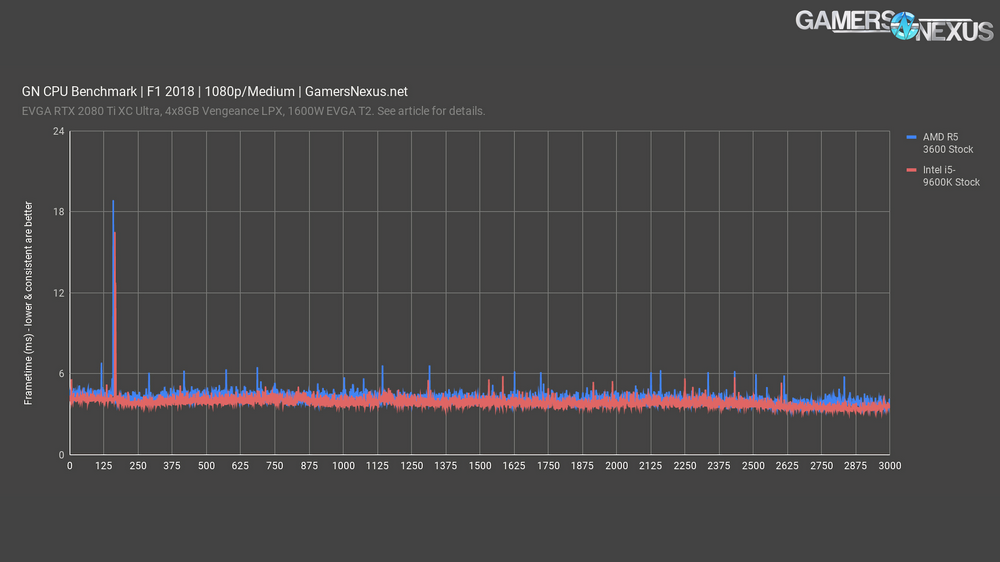
Here's a quick frametime chart with F1 2022 at 1080p. Recall, lower is amend, just more than consistent is better than just being lower. Overall, the R5 3600 remains close to 4.three-five.0ms frame-to-frame intervals here. Nosotros typically don't notice stutters unless there's an excursion equal to or greater than 8-12ms, something that only happens once in this benchmark, and it happens on both the 9600K and 3600 at the same spot in the test. Overall, these ii processors have similar frametime pacing and consistency, with the 9600K faster by 0.3ms on average.

The CPUs at 240 FPS average and higher up are almost entirely GPU limited, but all of our 3600 results fall just short of that range. The narrower range of results means that all three--stock, OC, and SMT disabled--averaged almost exactly the same. The 9600K still won-out by about four.5% stock versus stock, technically speaking, although the value of the 3600 is a tough match for it, particularly in later tests. The height-end of the results hit the GPU limit, so note that all differences are within error margins. That's why the 9900K OC isn't at the top -- they're bouncing off of limits, and and then any delta is only run-to-run variance.
Games - Civilisation VI

We do multiple passes of the new Gathering Tempest AI criterion for Civilisation Six, each of which takes an average completion time for 5 turns, and and so boilerplate those numbers together. It's the only game test we do that doesn't measure frametimes, and the results are extremely consistent. We look at plow fourth dimension instead, as this is entirely CPU dependent and heavily impacts how enjoyable the experience is. Unfortunately, despite being an AI benchmark, it shows a strong preference for frequency over thread count as can exist seen by the R5 1600 (3.2GHz base) outperforming the R7 1700 (3GHz base). The 9600K stock took 34 seconds to complete each turn, reducing average turn fourth dimension by 5% versus the R5 3600 stock, and the overclocked 9600K is far beyond the overclocked 3600 in performance at thirty.3 seconds versus 35.3. Multiplied across all 5 AI turns, that means information technology'd take an actress 25 seconds per turn for the human player to have input again, and that'd be more exaggerated as the game grows complicated.
Games - Assassin's Creed: Origins

Assassin's Creed Origins has revealed itself to be one of the nearly balanced titles we test in terms of benefitting from frequency and loftier core count. Disabling SMT had an accordingly negative event for once, then it's the stock 6C/12T 3600 upshot that slightly edges out the 9600K by 1.one FPS. Interestingly, the overclocked results for the two CPUs are fairly close as well: the 12 threads of the 4.3GHz 3600 bring it closer to the 5.1GHz 9600K than usual, with only a 7.4% advantage for the Intel flake. The 3600 is besides the first of the AMD X600 CPUs to break threescore FPS in the 0.1% lows, which it does even at stock frequencies.

The 3600, 3600 OC, and stock 9600K are all inside margin of error of each other at 1440p, with results pushed closer together by GPU constraints. The 9600K OC still has the advantage, though.
Games - GTA V

The oldest game on our demote nevertheless has some life left in it thanks to some settings tweaks to further load the CPU. It's another championship where disabling SMT allowed for a performance increase of a few FPS, but non past the stock 9600K this fourth dimension. Frequency is important in this title, and the lack of major comeback with the 3600 overclocked again indicates how close the stock boost frequencies already are to the maximum achievable all-core overclock. We'll exist interested to run into whether the 3600X tin can justify its $50 higher toll with what seems like very trivial room for improvement. AMD's generational improvements are as potent as ever here, with a 20.7% improvement over the stock 2600 and a 37.4% comeback over the stock 1600.

Scaling betwixt 1080p and 1440p is near perfect for GTA V, with only the nearly-tied OC 2700X and the stock 7600K trading places. The FPS numbers themselves are also barely inverse, pregnant we're a healthy altitude from a GPU bottleneck or the observed FPS cap of about 187.
Games - Shadow of the Tomb Raider

Shadow of the Tomb Raider is another one of the minority of games where leaving SMT enabled gave us better results. The stock 3600 showed an eighteen.iii% improvement in average FPS over the stock R5 2600, but with barely whatever further improvement from overclocking. The generational improvements are large, merely it's the aforementioned story every bit it has been: manufacturers squeeze performance out of parts more than efficiently, stock performance goes up, and overclocking headroom goes down. The 9600K is i role that even so has some room left, though, and the v.1GHz OC put information technology 13.2% alee of the overclocked 3600.
Games - Hitman 2
Due to popular demand, we've switched to DX12 for our Hitman 2 testing. DX12 back up was patched into the game relatively recently and any previously published benchmarks from us were done using the DirectX eleven version of the game. Annotation that Dx11 has meliorate frametime operation than Dx12, merely so many people seemed to adopt a different graphics API that we decided to just move to information technology, even though frametime performance is worse.

Hitman two showed a reassuringly strong preference for SMT on rather than off, with a 7.9% improvement from the extra threads, slightly better even than the 6C/6T stock 9600K. Our testing with the 8C/16T 9900K showed much meliorate results with hyperthreading disabled across multiple tests and retests, and sixteen threads isn't exceeding some threshold considering the 8C/16T three.9GHz 1700 outperforms the 6C/12T 3.9GHz 1600, so it must be downward to how Hitman ii treats thread count. The 4.3GHz overclock on the 3600 was as disappointing every bit it was in every other test, leaving Hitman ii'south universally bad 0.1% lows unaffected. For this CPU, you're really getting then much out of stock operation that a higher power-consuming OC is getting tough to argue in games. The R5 3600's out-of-box operation is highly competitive with Intel'due south similarly priced CPUs already, including in games, and a big leap over the previous ii generations.

The 1440p results stack up the same way the 1080p results did: 9600K OC better than 3600 OC but by a smaller than usual margin, 3600 stock just barely meliorate than 9600K stock, and the 3600 with SMT disabled trailing well backside the normal 6C/12T event.
PRODUCTION BENCHMARKS
GNU Compiler Drove

Our GNU Compiler Drove benchmark is basically a cache benchmark, something that's illustrated clearly by this chart. This demonstrates how quickly the CPU completes our code compile benchmark; it is not, withal, benchmarking compilers or testing compile quality. The faster and higher core count CPUs, and particularly Intel CPUs, would do better in some other lawmaking compile environments, only compiling GCC with GCC is "cache hits all the way down," equally Wendell of Level1 Techs described it to united states of america. In this respect, we tin functionally use this test as an illustration of the impact of having so much L3 cache. By all counts, the overclocked 2700X should win confronting an R5 3600, simply the 3600 has 35MB of L3 cache to the 2700X'south 16MB of cache, and that'south why the 3600 wins this nautical chart. If you happen to piece of work in a similar environment to this, basically Cygwin or Mingw compiling on Windows, the higher enshroud will help. We may have accidentally discovered AMD'due south new favorite benchmark, as i of our Patreon subscribers noted.
7-Nil Pinch & Decompression

Our next benchmarks are for compression and decompression with 7-Zip.
With compression, the R5 3600 pushes 55,000 one thousand thousand instructions per second, ranking it between the 1700 at 3.9GHz and 9700K at v.1GHz. The bigger story is that a 3600 at 4.3GHz all-core performs about where a 5.1GHz 9700K does and non distant from the 2700X stock CPU. Generationally, we see an improvement of 27% over the 2600 and 46% over the R5 1600 CPUs.

Decompression is next. In this examination, the R5 3600 pushes 72,000 MIPS, roughly tying it with a 9700K at 5.1GHz and belongings a strong lead over the price comparative 9600K, which isn't even in consideration, at this point.
Adobe Photoshop CC 2022 CPU Benchmark

Adobe Photoshop is up next. Like Premiere, Photoshop prefers frequency first. Performing transforms, warps, applying filters, colour changes, and resizes, nosotros see the 9900K illustrate what Photoshop likes in a processor. The 9700K's 5.1GHz result existence and so shut to the 9900K's 5.1GHz consequence is useful for demonstrating that frequency matters first for Photoshop. The R5 3600 ends upwardly nearly tied with the i5-9600K stock CPU, leading information technology by nigh ii%. Overclocking the R5 3600 gets it to 979 points, an comeback of just two.3%. The 9600K with an overclock leaps by thirteen%, from 942 points to 1065 points. AMD'south R5 tin can hold its own here, only frequency dependence in Photoshop does shift the recommendation to be less strongly towards the 3600.
Blender CPU Benchmarks

Blender ii.79 is next. This is a real awarding for 3D modeling and blitheness, and is the very one we used for our GN intro animation in these videos. The GN Monkey head render gives CPUs a mixed but heavy workload to crunch. For this one, the R5 3600 stock CPU finishes in 24.8 minutes, ranking it as faster than the 8700K and just nether a infinitesimal slower than the five.1GHz 9700K. Blender has an organic apply for the loftier core count on AMD's mainstream CPUs and doesn't lean as heavily on frequency, though it obviously still matters. Generationally, the R5 3600 finishes the render faster than the R5 2600'southward 31-minute effect past 20%, with the 1600'southward 35-minute effect reduced past thirty% on the 3600. The 3600 completes the return significantly faster than Intel's similarly positioned 9600K stock and overclocked results. Overclocking the 3600 ties it with the R7 1700 at 3.9GHz, illustrating that AMD has brought $330 performance from 2022 to the $200 price form in 2022.

The GN logo is a heavier workload. Not much changes, only the 9700K at v.1GHz moves up the ranks more before, meeting the 2700X. The R5 3600 is shut to both of these when stock, and an overclock gets it but a fourth dimension reduction of 4.2%. Non much from the express OC headroom in this ane.
Adobe Premiere CC 2022 CPU Benchmarks

Our Adobe Premiere benchmarks are next, using a 1080p show report project with a-roll and b-roll, followed by a 4K project that's heavily comprised of b-curl shots. We're rendering without the IGP, in the instance of Intel, then there would be some potential functioning uplift if IGP use is adequate in your organisation.
The 1080p show written report renders in iv.8 minutes on the AMD R5 3600; as discussed in the past, Premiere and Photoshop are withal heavily frequency-dependent, only the R5 3600 does well to reduce render time versus the stock R5 2600's 5.ix-minute result. An 18% decrease in render fourth dimension, stock-to-stock and generationally, is a major lift where AMD needed it. AMD has been weak in Adobe applications, then the IPC and clock increase help here. For reference, an overclocked 2600 rendered the file in 5.5 minutes, with the 1600 stock CPU from 2022 rendering it in half-dozen.7 minutes, making the 3600 about 28% less time-intensive.Compared to the i5-9600K, a processor with comparatively fewer threads, AMD's R5 3600 finally begins to pull ahead in ane of AMD's weakest realistic production workloads. Intel'due south stock 9600K and its 5.6-infinitesimal result sits closer to the R5 2600 at 4.2GHz. Overclocking the Intel CPU to five.1GHz, it ends upwardly near tied with the 3600. The R5 3600 finishes in about the same time as the 3.9GHz 1700 from a few years ago, basically a 1700X, for reference, and not far backside the i7-9700K. Intel'southward i9-9900K is notwithstanding the leader in the non-HEDT space for Adobe Premiere. If your job involves making videos, especially with similar settings to what yous'd find in our own, yous're probably still going to want to use the 9900K or similar for a cheaper professional person solution.

The 4K render is a heavier workload. For this 1, the Intel i9-9900K predictably chart-tops at 11.9 minutes stock. More relevant to our conversation today, the R5 3600 finishes the render in 14.2 minutes, assuasive the more expensive 9900K a time requirement reduction of 16% when both are stock. The R5 3600 outperforms the stock 9600K with an eighteen% fourth dimension reduction, farther managing to finish in 7% less fourth dimension than the overclocked 9600K. Generationally, the R5 3600 stock CPU outperforms the stock 2600 CPU's eighteen-minute effect past about xx%, or about 28% shorter time than the R5 1600's xix.8-minute result. Finally, an overclock on the R5 3600 allows it to finish in nigh 3% less time than the stock 3600.
5-Ray

V-Ray is a popular awarding past Chaos Grouping that workstation users have requested in our benchmarks. This 1 is measured in return time past minutes, then lower is once more better. The R5 3600 CPU finishes the V-Ray criterion return in 1.45 minutes, landing information technology near an i7-8700K stock render fourth dimension and ahead of the one.54-infinitesimal R5 2600 4.2GHz render time. Generationally, the R5 3600 stock CPU completes the render in 16% less fourth dimension than the R5 2600 stock CPU's 1.73-minute render, or nearly 26% faster than the R5 1600 stock CPU. The R5 3600 finishes the render in nearly 23% less time than the Intel i5-9600K, illustrating that V-Ray does actually utilize the threads. Overclocking the 9600K closes the gap, ranking at 1.6 minutes, only it's not plenty. The 3600 with an overclock is virtually the R7 1700 at 3.9GHz, and overclocking an R7 2700 would get you to about R7 2700X levels of performance, or 1.25 minutes. This again shows that there may be even amend value with buying a 2700 CPU and overclocking it; at least, there would be for some workloads.
Determination
For a video maker with a stricter budget, the AMD Ryzen 5 3600 is superior to its immediately price-matched competition from Intel, although yous may exist amend served by purchasing an R7 2700 on steep sale and overclocking it. That'd state y'all at our overclocked 2700X issue of 4.3 minutes for the 1080p Premiere render and would cost about $200 today, merely that inventory will stop beingness fabricated at some point, if not already. Even in the $200-$250 range, there'southward no point in buying a 9600K if Premiere will be office of your regular activities, or any rendering software that can brand use of more than vi cores. Nosotros'll be doing streaming benchmarks later on equally part of our ongoing Ryzen 3000 coverage, but for now we can at least say that the 3600 is the amend selection for streamers that plan to edit and return footage.
If AMD is its own biggest competition, then they've done a great job on the gaming side of differentiating the 3600 from the 2600 and 1600, X SKUs or otherwise. In that location are significant generational improvements over the other 6C/12T parts with clocks being pushed closer to the max out of the box--in that location'southward notwithstanding freedom to overclock, only there'south less and less point to pushing an all-core OC on AMD parts at room temperature. We're hoping for better results from Precision Boost Overdrive, so stay tuned for that testing. The i5-9600K outperforms the 3600 in most of our game benchmarks as games take been slow to adapt to CPUs with more than than 8 threads, and the 5GHz+ overclocking potential of the 9600K makes information technology an even clearer winner for exclusively gaming, but the R5 3600 is the more versatile and potentially cheaper option at $200 MSRP. The big question is whether the $250 R5 3600X that AMD (not united states of america) bills equally their 9600K competitor will be worth the extra money, or whether it's a repeat of commencement generation Ryzen where R7 1700s could be clocked to the same speeds as 1800Xs.
Our content is made possible by your support, especially via the GN Store products and Patreon. If you would like to support these colossal efforts, please consider buying i of our new GN Toolkits (custom-made for video card disassembly and arrangement building, using high-quality CRV metals and our ain molds) or ane of our arrangement building modmats. We as well sell t-shirts, mousepads, video carte anatomy posters, and more.
Editorial & Test Lead: Steve Burke
Editorial, Testing, Data Validation: Patrick Lathan
Video: Andrew Coleman, Josh Svoboda, Keegan Gallick
Quality Control: Keegan Gallick, Steve Burke

Source: https://www.gamersnexus.net/hwreviews/3489-amd-ryzen-5-3600-cpu-review-benchmarks-vs-intel
Posted by: millerhambir.blogspot.com
0 Response to "How To Install Ryzen 5 3600 Cpu"
Post a Comment